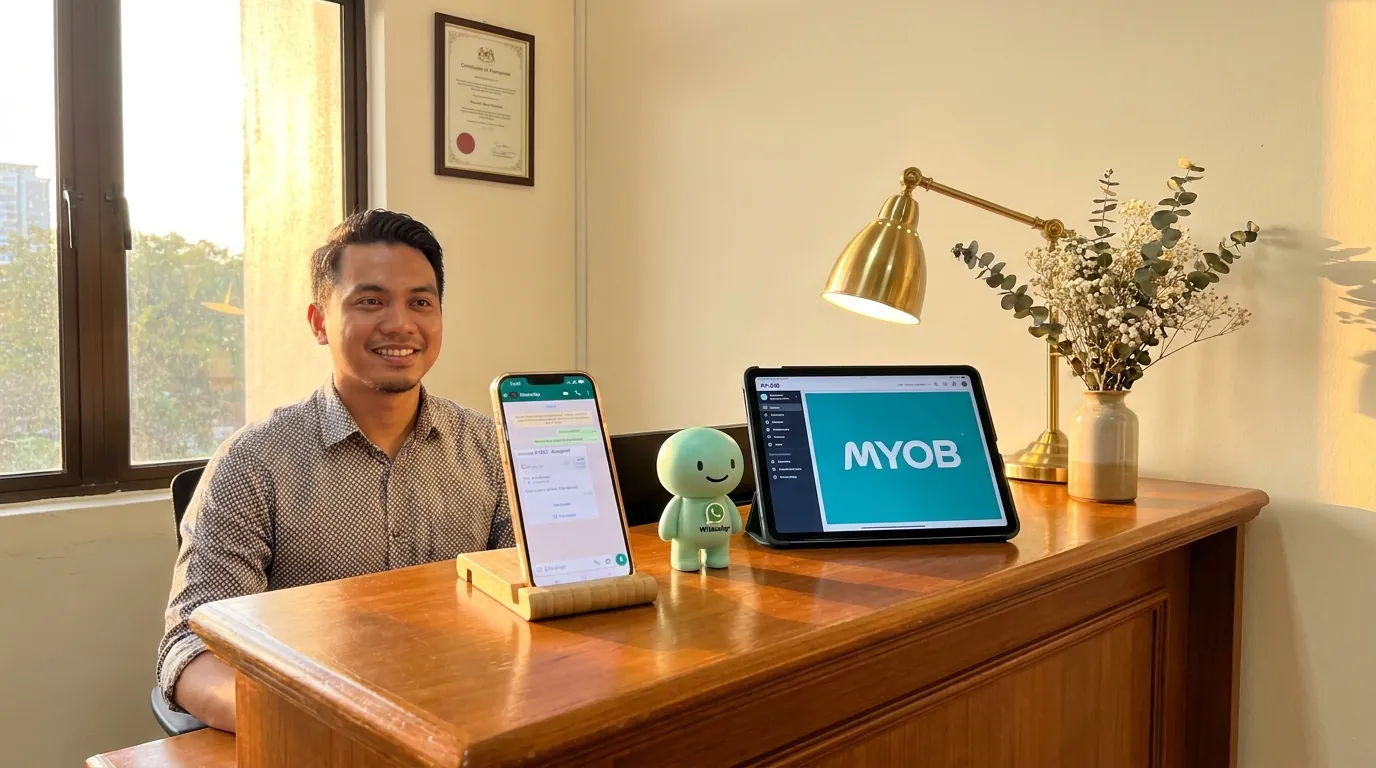
How to send WhatsApp messages from MYOB (the no-wait way)
The Meta Embedded Signup process for the WhatsApp Business API takes 2–4 weeks for most Australian, New Zealand, Singaporean and Malaysian small businesses. There is a faster path. Here is what it looks like on MYOB — in AUD, NZD, SGD, MYR, and every language your customer writes in.
minidesk · Editorial team, minidesk
You run your business on MYOB. Your customers live on WhatsApp — every invoice reminder, every balance enquiry, every delivery update, every complaint. The first time you try to connect the two — to send an invoice reminder, a balance reply, a delivery update — the Meta Embedded Signup process starts, the Meta business verification queue starts, and the two-to-four-week clock starts. There is a faster path. Here is what the faster path looks like on MYOBMYOB, in AUD, NZD, SGD, MYR, and every language your customer writes in.
Why the BSP route is slow — in every country MYOB serves
The WhatsApp Business API market runs through Business Solution Providers — WATI, Sleekflow, AiSensy, Twilio, MessageBird, the long tail. Every BSP requires the business to go through Meta Embedded Signup themselves, which means the Meta business verification queue, which means the 2-to-4-week wait. The Meta queue is not a BSP problem; it is a Meta problem, and no BSP can solve it on their own. The businesses that have already been verified are the ones whose number is already on the Business API; everyone else waits in the same queue.
The 2-to-4-week wait is not a guess. It is what Australian, New Zealand, Singaporean and Malaysian small businesses on the WATI and Sleekflow signup flows report, in the support forums, in the Facebook community groups, in the Reddit threads. The pattern is the same: you sign up, you submit the business verification documents, you wait, you get a generic response that asks for more documents, you wait, you eventually get approved. For a 4-person plumbing business in Brisbane, the wait is the difference between "we can start sending WhatsApp invoice reminders this week" and "we can start sending WhatsApp invoice reminders next month."
What Embedded Signup actually is
Meta Embedded Signup is the flow where a business authorises a third-party application to send WhatsApp messages on the business's behalf. The flow is supposed to be one click. The reality is a three-step process: the business owner authorises the application, Meta runs the business verification, the application gets the API credentials. The first step is one click. The second step is the wait. The third step is the part no BSP can shortcut — Meta owns the verification queue, the documents, and the timeline.
The documents Meta asks for vary by country and by business type. The Australian list usually includes: ABN registration, a sample of the business's website or Facebook page, and a phone number that matches the business name. The New Zealand list usually includes: NZBN registration, a sample of the website, the same phone-number check. The Singaporean list usually includes: ACRA registration (UEN), the same website check, the same phone-number check. The Malaysian list usually includes: SSM registration, the same website check, the same phone-number check. The phone number is the part that catches a lot of small businesses — Meta does not allow a personal WhatsApp number on the Business API, and the porting process is a separate project.
The plug-in path — what minidesk actually does
minidesk holds the Meta Business verification. When you sign up and pick MYOB as your connector, three things happen in parallel: you connect your MYOB org with one OAuth click (cloud) or one translator install (on-prem), you connect your business WhatsApp number through Meta Embedded Signup, and you authorise the AI to read the MYOB invoices, contacts, reports, and bank transactions. The whole flow is twenty minutes, end to end, in Australia, New Zealand, Singapore, and Malaysia alike. The Meta review queue is skipped because the queue is for businesses that have not been verified yet — your verification rides on minidesk's.
The second part of the no-wait path is that the WhatsApp message already knows what the MYOB ledger says, in the right currency, the right tax label, the right contact name for the country the invoice was raised in. When the AI sends a message to a customer in Brisbane, the message reads in English, in AUD, with the GST line, on the MYOB invoice number. When the AI sends a message to a customer in Auckland, the message reads in English, in NZD, with the GST line. When the AI sends a message to a customer in Singapore, the message reads in English (or Mandarin or Bahasa, whichever the customer wrote in), in SGD, with the GST line. When the AI sends a message to a customer in Petaling Jaya, the message reads in Bahasa Malaysia (or English), in MYR, with the SST line. The AI is reading the same MYOB your bookkeeper reads, in the same currency, the same tax label, the same language the MYOB invoice was raised in.
What the conversation looks like in practice
It is 3:14pm on a Tuesday in Brisbane. A plumbing customer in Toowong sends a WhatsApp: "Can I get an update on invoice 1287?" The AI reads the phone number, identifies the customer from the MYOB contact list, finds the invoice, sees the payment landed this morning, and replies: "Hi Sarah, yes — invoice 1287 for AUD 480.00 was paid this morning via your CBA account. The receipt has been emailed. Let me know if you need anything else." The reply lands at 3:14:08pm, Brisbane time. Sarah reads it on the school run. The bookkeeper in the office is at a client meeting. The conversation is handled.
It is 10:42am on a Wednesday in Petaling Jaya. A customer in Subang Jaya sends a WhatsApp: "Boleh tahu status invois INV-2026-MY-0218?" ("Can I know the status of invoice INV-2026-MY-0218?") The AI reads the phone number, identifies the customer from the MYOB MY contact list, finds the invoice, sees the payment is pending the next bank feed sync, and replies in Bahasa: "Selamat pagi Encik Lim, invois INV-2026-MY-0218 untuk MYR 2,400 sedang diproses. Pembayaran terkini kami terima pada 8 Julai. Kami akan hantar resit setelah pembayaran disahkan. Boleh saya bantu dengan apa-apa lagi?" The reply lands at 10:42:04am, Kuala Lumpur time. Encik Lim reads it on the way to the office. The conversation is handled.
“We operate across Brisbane, Auckland, Singapore and Petaling Jaya. The WhatsApp AI is the first tool that handles all four markets without us having to teach it the local tax label, the local currency, the local WhatsApp number, or the local language.”
— Farah, who runs a 6-person accounting firm in Petaling Jaya
What to do if you are already on a BSP
If you are already on a Business Solution Provider — WATI, SleekFlow, AiSensy, Twilio, MessageBird, or any of the long tail — the good news is the WhatsApp number and the API credentials are already in your business name, and Meta has already verified you. The migration is the part you are weighing, not the setup.
The practical path is: keep the BSP contract running for one billing cycle while you set up minidesk in parallel. Connect your MYOB org with one OAuth click, let the AI read your data, and authorise the Meta Embedded Signup for your existing WhatsApp number through the minidesk console — the number is yours, the verification is yours, the migration is a settings change at Meta, not a new application. Test the AI on a small set of conversations — say, the top 10 customers across the four countries — and compare the messages the AI drafts to the messages your BSP has been sending. When you are comfortable, switch the routing over and cancel the BSP at the next billing date.
Common mistakes when you set this up yourself
Three mistakes we see most often, all worth naming. (1) Connecting a personal WhatsApp number instead of a business number — Meta does not allow a personal number on the Business API, and the porting process is a separate project. (2) Trying to set this up before the MYOB chart of accounts is clean — the AI reads what is in MYOB, and a chart of accounts full of one-off accounts makes every answer longer than it needs to be. (3) Skipping the test phase — the first WhatsApp the AI sends should go to your own number, so you can see the layout, the language, the currency, the speed, before it goes to a customer. We have made all three of these mistakes ourselves; that is why the install wizard walks you through each one.
What it costs (and what it does not)
The Meta conversation fees are the same fees every platform pays. minidesk does not add a per-message markup on top of Meta's. The plan is a flat monthly fee that includes the AI, the channels, the connector, and the WhatsApp API. No per-conversation surcharge. No 12-month contract. No setup fee. The pricing is on the website; the quote is the quote. The plan works the same in AUD, NZD, SGD, MYR, and the rest of the currencies MYOB supports.
If your business is already on MYOB, the WhatsApp path is the part of the AI you will use the most, and it is the part that takes the least time to set up. Twenty minutes from signup to the first message. The bookkeeper does not have to do anything different. The customer does not have to download an app. The message lands in the WhatsApp they already have open, in the language they already speak, in the currency the MYOB invoice was raised in.
→ See the MYOB integration: /integrations/myob