Is SQL Account an ERP? Honest take + how to AI-ize it
Depends who you ask. SQL Account themselves call it accounting software. Some of their dealers call it an ERP. The real answer, and why it matters when you are shopping for an AI layer.
minidesk · Editorial team, minidesk
Depends who you ask. SQL AccountSQL Account themselves call it accounting software. Some of their dealers call it an ERP when they are selling to a customer who wants the bigger word on the brochure. The real answer is in the middle, and the answer matters because the word \"ERP\" comes with a price tag the underlying software does not always justify.
What "ERP" means in Malaysia
An ERP — Enterprise Resource Planning system — is software that runs the whole business in one place. Sales, purchase, inventory, manufacturing, HR, payroll, fixed assets, project costing, multi-company consolidation. The traditional ERP vendors — SAP, Oracle, Microsoft Dynamics — sell to companies with 200+ staff and a finance team that can run a six-month implementation. The word carries weight, and the weight is mostly about scope, not quality.
In the Malaysian SME market, the word ERP gets used more loosely. A software that does accounting + inventory + some HR is sometimes called an ERP, sometimes called a business management system, sometimes called accounting plus. The label is whatever helps the dealer close the deal. The substance is whatever modules the software actually ships.
Where SQL Account sits on the spectrum
SQL Account is, strictly, accounting software with strong inventory and decent fixed-asset support. It does not ship HR. It does not ship payroll (you buy a separate product for that). It does not ship manufacturing. It does not ship multi-company consolidation in the way SAP Business One does. The dealers who call it an ERP are talking about the SQL Account suite — Account + Stock + Payroll + the dealer-written add-ons — which together cover maybe 70% of what an ERP covers.
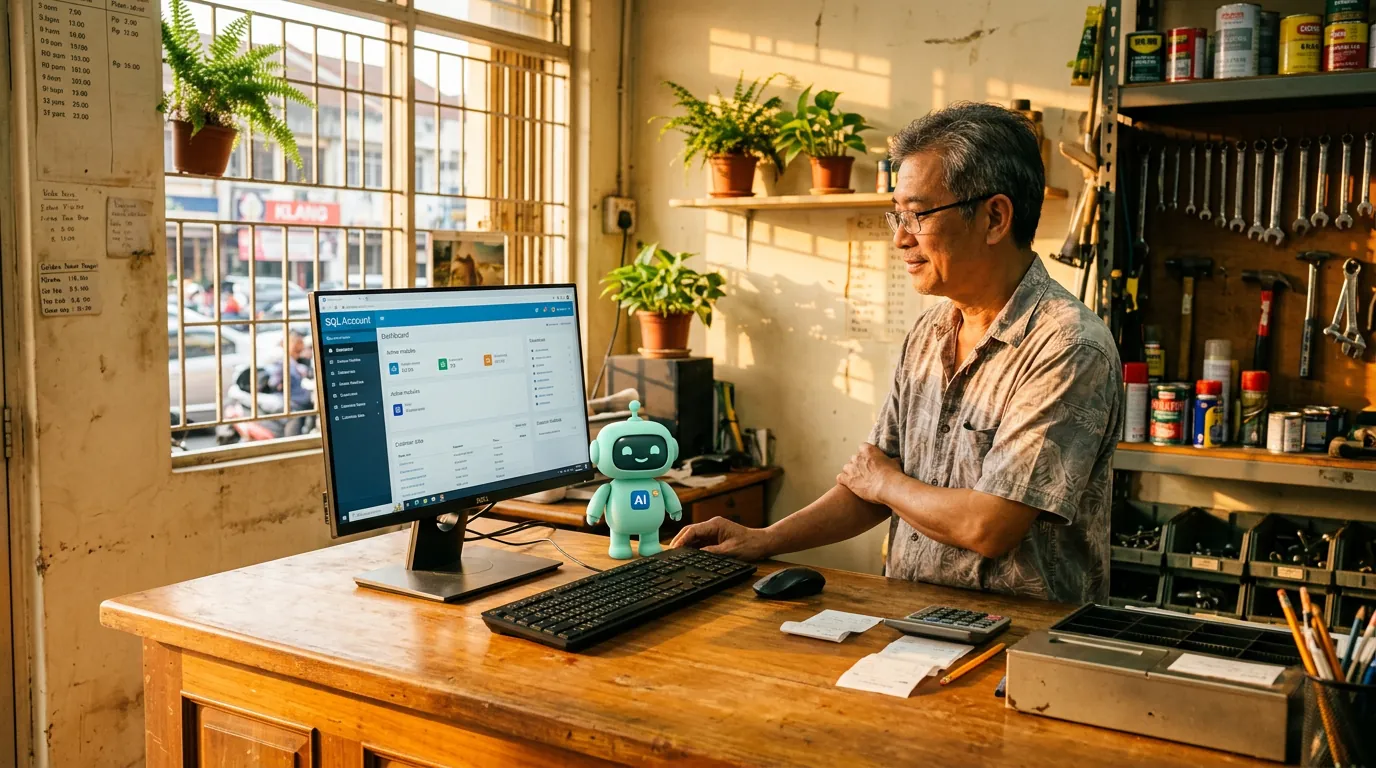
That 70% is exactly the segment where SQL Account wins in Malaysia. It is enough for a 20-person hardware shop in Klang. It is enough for a 50-person F&B distributor in Petaling Jaya. It is not enough for a 500-person manufacturer in Penang with three production lines and a job-costing requirement. SQL Account themselves know this. Their dealer network is built around the SME segment, not the manufacturer segment, for exactly this reason.
When to upgrade, when to AI-ize
The honest question is not "is SQL Account an ERP." The honest question is "is what SQL Account does enough for what my business needs, and if it is, where is the next layer of value going to come from." For most of the SMEs SQL Account serves, the answer to the first half is yes. The next layer of value is not a bigger chart of accounts. It is the AI layer that reads the chart of accounts and answers the questions the chart of accounts cannot answer on its own.
Upgrading to a full ERP — the SAP / Oracle / Microsoft Dynamics tier — is the right move when the business has outgrown what SQL Account can do, not when the business has outgrown what SQL Account can do without an assistant. The signal for "I need an ERP" is a manufacturing process that does not fit, a multi-country consolidation that does not reconcile, or a headcount over 200 with a finance team that can run the project. The signal for "I need an AI on top of what I have" is a Monday morning that starts with forty unread WhatsApps and a sales ledger that does not talk to the chat.
“I do not need a bigger system. I need the system I already have to talk to the customers who are already messaging me.”
— Tan, who runs a 12-person auto-parts dealer in Shah Alam
What to ask the vendor if you are shopping for a real ERP
If you have decided the word "ERP" applies to your business, the vendor conversation is the part that determines whether the next two years are a success or a write-off. Six questions worth asking, in the order the answers matter. (1) What is the implementation timeline, in weeks, from signed contract to first user login? (2) What is the all-in cost over 3 years, including licence, implementation, training, support, and the integrations you will need? (3) How does the system handle multi-company consolidation across the entities you operate today, and the entities you might operate in 3 years? (4) What is the cost of adding a 50th user, a 100th user, a 500th user? (5) How is the data isolation enforced — at the database level, in the application code, or in a policy document? (6) What does the support queue look like at 11pm on a Saturday, and is it staffed by humans or by an AI that does not know your business?
The answer to question 5 is the one that matters most for the long-term safety of your data. An ERP that enforces the data isolation at the database level is an ERP that cannot accidentally leak one company's data to another. An ERP that enforces it in application code is an ERP that will leak, eventually, when the application code changes. An ERP that enforces it in a policy document is an ERP that has not enforced it at all. The honest vendors will tell you which one they do, in one sentence, with a diagram. The dishonest ones will tell you they do "role-based access control," which is a different thing, and which is a polite way of saying the wall is in the prompt.
The honest case for staying on what you have
For the 80% of the businesses we talk to, the honest answer to "is it time for an ERP" is no. The honest answer is: the software you have is doing the job the software was bought to do, and the next ring of investment is not a bigger software, it is an assistant that makes the software you have do more. The bookkeeper does not need a new chart of accounts. She needs the chart of accounts she has to answer the WhatsApp that is sitting unread. The owner does not need a new dashboard. He needs the dashboard he has to read itself back to him in a sentence. The migration to a real ERP is a 6- to 18-month project that costs more than the software itself. The AI on top of what you have is a 20-minute install that pays for itself the first month. If you are the 80%, the AI is the right next step. If you are the 20%, we will tell you so — and we will tell you which ERP we would shortlist, because we have read the same industry analyses you have.
How to AI-ize the SQL Account you already run
The AI layer is a connector on top of the SQL Account you already paid for. The install is twenty minutes. The data does not leave your PC. The first answer the AI gives you is the answer you would have given yourself if you had eight more hours in the week. The chart of accounts stays. The bookkeeper stays. The Monday morning phone tag ends.
- 1Sign up at minidesk.co and pick SQL Account as your connector.
- 2Install the translator on the PC that already runs SQL Account. The install is signed, the size is small, and no data is uploaded to the cloud.
- 3Connect your business WhatsApp number. minidesk holds the Meta verification, so the typical 2–4 week wait is gone.
- 4Ask the AI a question — "who owes us over 30 days" — and watch it read your sales ledger and write the answer in a sentence.
- 5Hand the AI a workflow ("chase everyone over RM1,000 past 30 days every Friday at 4pm") and it does it, shows you the queue, and asks before anything goes out.
If your business is the size SQL Account was built for, the AI is the upgrade that does not require you to change the software that already works. If your business has outgrown SQL Account, no AI layer is going to fix that — and we will tell you so before you sign up. The honest answer is the one that saves you the most money.
→ See the SQL Account integration: /integrations/sql-account
Related reading