MYOB + AI: the layer that handles the MYOB-to-MYOB-MY rebrand
MYOB is the accounting software hundreds of thousands of Australian, New Zealand and Singaporean small businesses have been running for 40 years. The rebrand to MYOB MY in the Malaysian market has not been smooth. Here is what an AI layer on top of MYOB looks like, and how it handles the brand transition without losing your bookmarks.
minidesk · Editorial team, minidesk
MYOB has been busy on two fronts. The product team has shipped a long list of in-product AI features for the cloud products. The marketing team has rolled out the new MYOBMYOB MY brand across the Malaysian market, which has left a long tail of confused searches (\"MYOB MY\", \"ex-MYOB\", \"MYOB new brand\", \"is MYOB still around\") that today land on the wrong page. Here is what a different layer of AI looks like — and how it handles the rebrand transparently, on the MYOB ledger hundreds of thousands of AU / NZ / SG / MY businesses already run.
What the in-product AI does, and what it does not
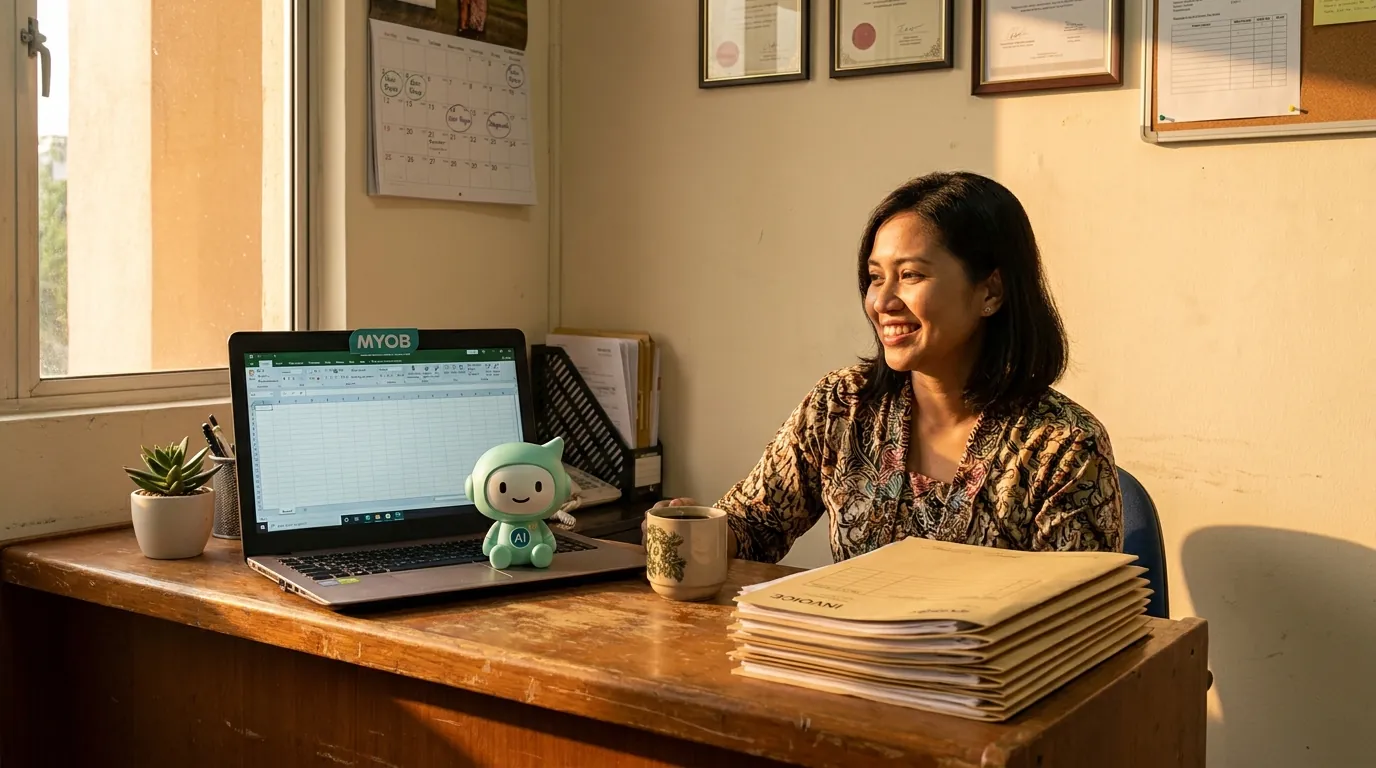
MYOB's in-product AI features are anchored to the MYOB interface. You open MYOB, you ask the assistant, the assistant reads the MYOB data, the answer appears in the side panel. The data the assistant can see is the data inside MYOB — the chart of accounts, the invoices, the bank feed, the reports, the BAS / GST summary. The data the assistant cannot see is the data outside MYOB: the WhatsApp thread, the customer's email, the e-commerce platform, the POS, the warehouse system, the project tracker, the other MYOB orgs in the group.
The second layer of AI is the layer that reads the data outside MYOB and writes the answers into the channel the customer is actually using. The second layer does not replace the first — your bookkeeper keeps the in-product workflow they already know — it adds the channel, the language, the cross-entity view, and the cross-software view that the in-product assistant was never built to cover.
The MYOB-to-MYOB-MY rebrand, and why it matters for the search traffic
MYOB has been the canonical name in Australian, New Zealand and Singaporean small-business accounting for 40 years. The MYOB brand is a household name in those markets the way SQL Account is in Malaysia. The 2025 rebrand of the Malaysian product to "MYOB MY" was a marketing move intended to localise the brand for the Malaysian market, but the long tail of confusion has not been kind. Teams searching "MYOB MY" do not always know whether MYOB MY is a new product, a new skin, a new company, or a new name for the same product. Teams searching "ex-MYOB" are sometimes looking for the vendor that came before Financio in the Vietnamese market (Financio was briefly branded as "MYOB Vietnam" before the rebrand). Teams searching "MYOB new brand" are typically the Malaysian accounting firms trying to figure out which product to recommend to a client who has just seen the new logo.
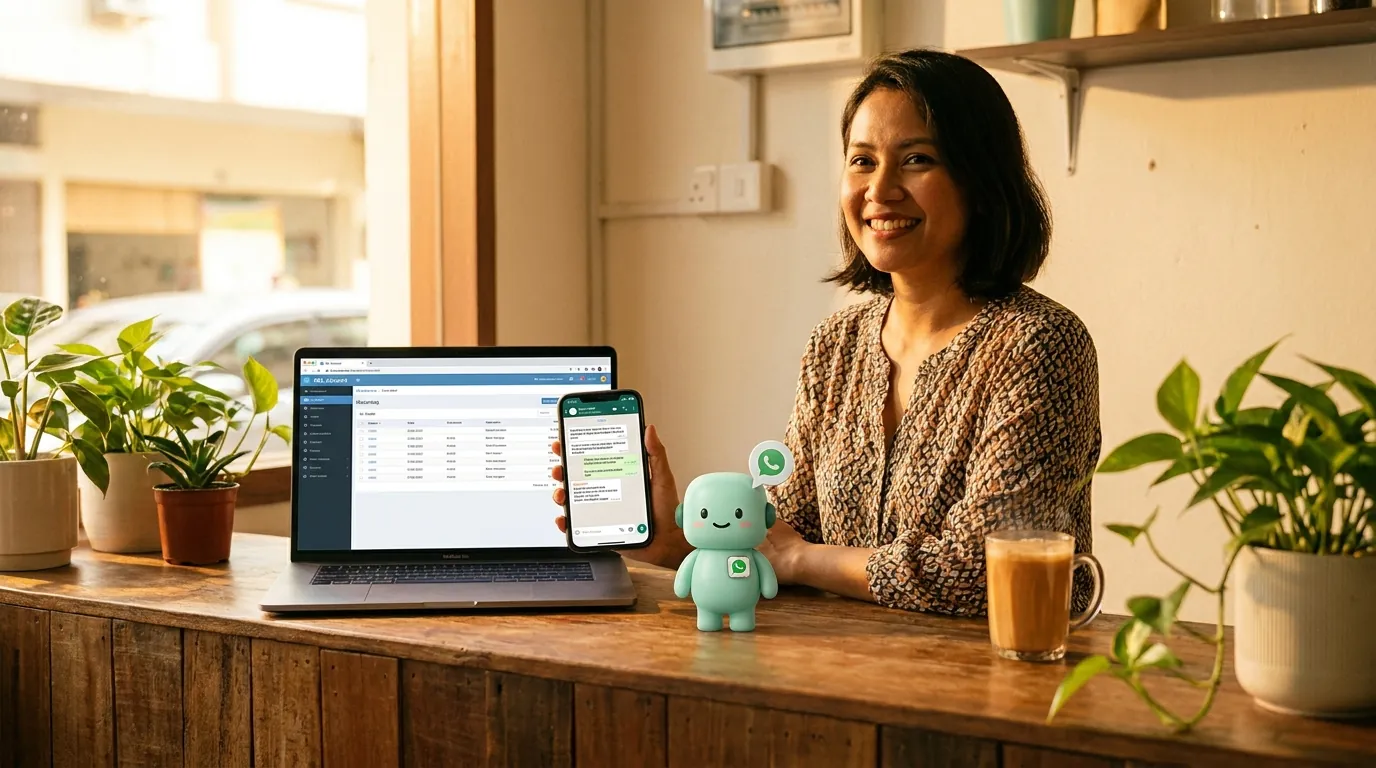
The minidesk AI is the layer that handles the rebrand transparently. Whether the org is still branded MYOB or has been migrated to the MYOB MY skin, the AI reads the same ledger, in the same currency, on the same OAuth flow. The brand is the wrapper; the data is the data; the AI is the layer that talks to the data, not to the wrapper. A bookkeeper in Petaling Jaya who has just been told "we have moved to MYOB MY" can connect the new MYOB MY org with the same OAuth click, the AI reads the same chart of accounts, the same contact list, the same sales history, and the WhatsApp replies go out in the same Bahasa Malaysia the customers have been receiving. The rebrand is invisible to the AI, the AI is invisible to the rebrand, and the bookkeeper does not have to do anything different.
Three concrete use cases
1 · The Brisbane tradie that runs MYOB Essentials and WhatsApp
Dave runs a 4-person plumbing business out of Brisbane. The business runs MYOB Essentials — the cloud product, with the bank feed, the BAS-ready reporting, the single-touch payroll. The customers live in WhatsApp. The two-office staff split the WhatsApp inbox between them. They spend the first hour of every morning answering questions the MYOB dashboard could answer in three seconds — what is my balance, has the deposit cleared, when is the next service due. By 9am, the actual service work has not started.
With the second layer of AI, the WhatsApp inbox is the assistant's inbox. A customer in Toowong sends a WhatsApp at 7:14am: "Can I get a copy of invoice 1287?" The AI reads the MYOB Essentials invoice record, finds the PDF, and replies: "Hi Sarah, here's invoice 1287 for AUD 480.00, paid on 14 July. The PDF is attached. Let me know if you need anything else." The reply goes out at 7:14:08am, Brisbane time. Sarah reads it before the school run. The conversation is handled. Dave is on his way to the first job.
2 · The Singapore agency that runs MYOB in two currencies
Jasmine runs a 9-person creative agency in Tanjong Pagar. The firm is Singaporean-owned but the clients are a mix of local SGD clients and Malaysian MYR clients, and the MYOB org is set up with two currencies. The firm's bookkeeper is good at MYOB but she is one person, and the cross-currency questions — "what is our total receivables in MYR, what is our total in SGD, what is the consolidated view" — take her half an hour every Monday. By the time the report is in Jasmine's hand, the team is already in the weekly meeting.
With the second layer of AI, the cross-currency view is one ask. Jasmine opens the AI at 8:14am on Monday: "Show me the cross-currency A/R aging." The AI reads the MYOB org, ranks the customers by total exposure, identifies the cross-currency customers (the same company name appearing in both SGD and MYR), converts the totals at the day's mid-rate, and writes the report in one short message. The bookkeeper reviews the AI's draft, makes the two adjustments the AI would not know to make (the intercompany loan reconciliation, the disputed invoice), and the report is in Jasmine's inbox by 8:45am. The weekly meeting starts on time.
3 · The Malaysian accounting firm that handles the rebrand questions
Farah runs a 6-person accounting firm in Petaling Jaya. Half her clients are on the legacy desktop MYOB (the product the firm has been recommending since 2010); half are on the new MYOB MY cloud product (the product the firm is now recommending since the rebrand). The clients ask the same question every week: "should I move to MYOB MY?" The answer depends on the client's chart of accounts, the client's bank feed, the client's payroll size, and the client's tolerance for the migration. The answer takes 30 minutes per client. The firm has 80 clients. The answer is 40 hours of unbilled time.
With the second layer of AI, the answer is one ask. The AI reads the client's MYOB org (whether it is the legacy desktop or the new MYOB MY cloud), identifies the chart of accounts, the bank feed, the payroll size, the historical transaction volume, and writes the migration assessment in one short message. The message says: "Client X has 1,240 active accounts, 12 bank feeds, 4 payroll employees, and 18 months of transaction history. Migration to MYOB MY is feasible; the chart of accounts will need 14 hours of cleanup; the bank feeds will need 3 hours of re-connection. Total estimated migration cost: 17 hours. Recommendation: migrate in Q4 if the client's bank feed reconciliation is current; hold if the client is mid-year-end." The accountant reviews the AI's draft, makes the call, and the client gets the answer in 10 minutes instead of 30.
“We run three MYOB orgs, two currencies, and the MYOB-to-MYOB-MY rebrand all at the same time. The AI is the layer that finally gives us a single view of all of it, and handles the rebrand without us having to write a memo.”
— Farah, who runs a 6-person accounting firm in Petaling Jaya
Why the same AI shape travels across the AU / NZ / SG / MY markets
The reason the same AI shape wins in Australia, New Zealand, Singapore, and Malaysia is the same reason the same content shape wins on every global accounting product. The buyer journey is the same. A bookkeeper who runs their firm on MYOB Essentials in Brisbane is asking Google the same question a bookkeeper who runs their firm on MYOB AccountRight in Auckland is asking: "can I add an AI to MYOB?" The country changes; the long-tail keyword does not. The compliance hook changes — ATO BAS in Australia, IRD GST in New Zealand, IRAS GST in Singapore, LHDN SST in Malaysia — but the structure of the question is identical: a small or mid-market business owner who chose MYOB because it was the right ledger, and now wants an AI layer on top because the ledger still does not answer the WhatsApp.
The honest limits of the AI
Three limits worth naming, because the limits are the part nobody else puts in the brochure. (1) The AI reads the MYOB data you have connected. If the chart of accounts is a mess, the answers will be longer than they need to be. (2) The AI does not write back to MYOB. Every change to the ledger stays in MYOB, exactly where your bookkeeper made it — the AI is a reader and a writer of WhatsApp, not a writer of ledgers. (3) The AI is not a replacement for a bookkeeper. It is the layer that lets the bookkeeper stop copying numbers into WhatsApp. The bookkeeper still reviews the BAS / GST / SST summary, still signs off on the multi-entity consolidation, still owns the books.
How to add the AI to your MYOB
Three steps, end to end in twenty minutes for the cloud products (Essentials, AccountRight Live, MYOB Acumatica) and a little longer for the on-prem AccountRight classic installs (the translator pattern, the same Windows-agent shape as SQL Account). (1) Sign up at minidesk.co, pick MYOB as the connector, and authorise the OAuth — the same flow you use to link Google Calendar to a third-party app. minidesk requests only the scopes the AI needs: read invoices, read contacts, read reports, read bank transactions. (2) Connect your business WhatsApp number through Meta Embedded Signup. minidesk holds the Meta Business verification, so the typical 2-week Meta wait is gone. (3) Hand the AI its first workflow — "every Monday at 9am Sydney time, draft the BAS-ready summary from MYOB and post it to the in-app review queue" — and the first message lands the next Monday.
If you have a multi-entity business and want the cross-entity view first, the install wizard walks you through picking the orgs the AI should read. If you are handling the MYOB-to-MYOB-MY rebrand for a client, the wizard walks you through reading both the legacy and the new MYOB MY org in parallel, so the AI can write the migration assessment side-by-side. If you operate across Australia, New Zealand, Singapore, and Malaysia, the wizard walks you through the per-country WhatsApp number — each country gets its own WhatsApp connection, the AI handles the cross-country routing from the same MYOB orgs.
→ See the MYOB integration: /integrations/myob
Related reading