ERP software in Malaysia (2026): what to pick, what to skip, and how to AI-ize what you already run
The word "ERP" in Malaysia is mostly marketing. The local accounting vendors — SQL Account, AutoCount, UBS, Bukku, Financio, Million, QNE — ship the ledger, the GST module, the SST module, the payroll. The local POS vendors — StoreHub, FeedMe, Slurp, Loyverse — ship the till, the menu, the inventory. The decision is not which ERP to buy; the decision is which software to AI-ize.
minidesk · Editorial team, minidesk
The word "ERP" in Malaysia is mostly marketing. The local accounting vendors — SQL Account, AutoCount, Access UBS, Bukku, Financio, Million, QNE — ship the ledger, the GST module, the SST module, the payroll, and (in some cases) the inventory. The local POS vendors — StoreHub, FeedMe, Slurp, Loyverse — ship the till, the menu, the inventory, the kitchen display, the e-invoice batch. The decision most Malaysian SMEs are weighing in 2026 is not which ERP to buy — it is which software to AI-ize, and which software to skip. Here is the honest read on the local market, the local vendors, the local decision, and the layer on top of the software you already run that gives you the AI without the migration.
What "ERP" means in MY (and why the term is mostly marketing)
The word "ERP" — Enterprise Resource Planning — was coined for the SAP / Oracle / Microsoft Dynamics tier: a single database that runs the general ledger, the A/P, the A/R, the inventory, the manufacturing, the supply chain, the HR, the payroll, the multi-entity consolidation, the multi-country consolidation, all at the same time, for a 500- to 50,000-person business. The word has been borrowed by every vendor in the SME tier to mean "the system that runs your business." The borrowing is the marketing. The borrowing is also where the confusion starts.
A Malaysian SME that buys SQL Account is not buying an ERP. They are buying the most-installed desktop ledger in Malaysia, with the chart of accounts, the debtor master, the creditor master, the stock module, the GST module, the SST module, the payroll add-on, the e-invoice module, and the dealer network that supports the install. The same applies to AutoCount, Access UBS, Bukku, Million, QNE, and the rest. Each vendor is a real piece of business software. None of them is an ERP in the SAP / Oracle sense. The honest vendors know this. The dishonest ones borrow the word in their marketing and hope the buyer does not check.
The reason the word has been borrowed is the same reason the local-software-AI wedge from seo.md §0a works: the Malaysian SME market is not buying an ERP, it is buying the local ledger, the local POS, the local payroll, the local compliance module, and the local dealer network. The "ERP" word is the vendor's way of saying "we ship the whole thing you need, you do not have to buy five different products." That is a real promise, and the local vendors mostly deliver on it. The promise does not make the product an ERP. The promise makes it a coherent SME business software stack, built by a Malaysian team, sold by a Malaysian dealer, supported in Bahasa Malaysia and English.
The local accounting vendors (the six that matter)
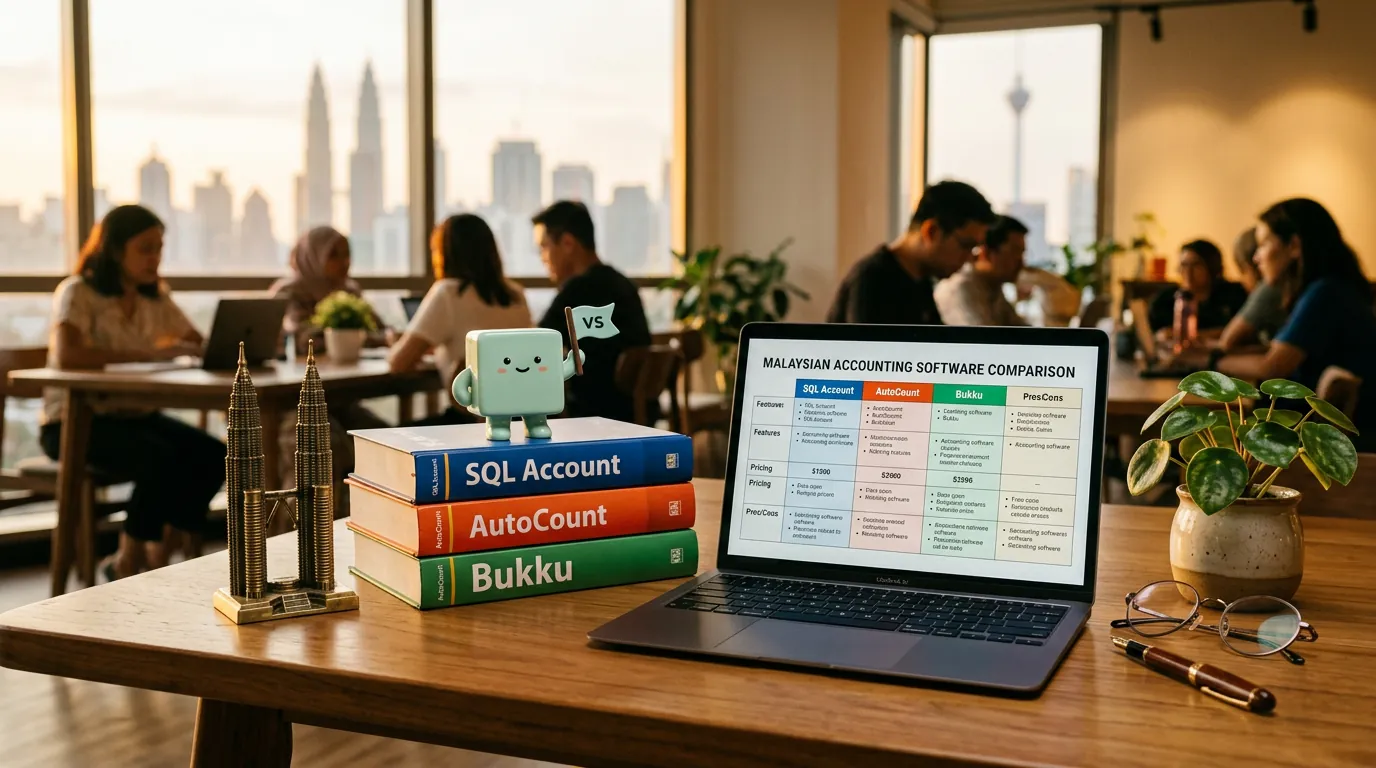
The six local accounting vendors worth knowing in 2026, in the order of the install base:
- 1SQL Account — the desktop ledger with the largest claimed install base in Malaysia (270k-320k, per the A-2 audit). SQL Account is the wedge vendor. The product is a Windows desktop app, on a local SQL Server or Firebird database, with the chart of accounts, the GST/SST module, the payroll add-on, the e-invoice module, the dealer network in every state. The product is the one the next 10 SME owners you meet are most likely to be running.
- 2AutoCount — the desktop + cloud accounting product, with two product lines (AutoCount Accounting on the desktop, AutoCount Cloud on the browser). The dealer network is the deepest after SQL Account, and the cloud product is the one the new owners are picking. The cloud product has a public API; the desktop product uses the same translator pattern as SQL Account.
- 3Access UBS (ex-Sage UBS) — the desktop accounting product tens of thousands of Malaysian accounting firms and SMEs have run since the early 2000s, first as Sage UBS, now under the Access Group. The cleanest "obsolete software" story in the market — the install base is huge, the API is not exposed, the dealer network is shrinking, and the customers are exactly the ones who would benefit from an AI layer on top.
- 4Bukku — the cloud-native accounting product, fastest to a "real working integration" demo because the API is public. Bukku is the one the new cloud-first Malaysian SMEs are picking, and the one the international cloud accounting products (Xero, QuickBooks) are competing with for the same customer.
- 5Million Accounting — the desktop accounting product with a smaller install base and a thin SERP. The product is real, the dealer network is real, the customers are the ones who have been on the same .MDB file since 2010 and are not about to migrate.
- 6QNE / N3 — the cloud accounting product that already ships its own AI for general-ledger queries. The honest positioning is "the AI alternative" — QNE ships an in-product AI; minidesk is the second AI on top, the one that adds the WhatsApp channel, the cross-software view, and the vendor-aware AI for the non-QNE data sources.
The local POS vendors (the four that matter)
The four local and global POS vendors the Malaysian F&B and retail SME market actually runs, in the order of the install base:
- 1StoreHub — the cloud POS thousands of Malaysian F&B outlets, retail shops and salons run. The product is the till, the menu, the inventory, the customer database, the employee management, the e-invoice batch, the integration marketplace. StoreHub is the cloud POS the new F&B chain is most likely to be running.
- 2Loyverse — the global smartphone-first POS thousands of cafes, salons, retail shops and service businesses in 80+ countries run. Loyverse is the POS the pop-up, the market stall, the food truck, the salon chair is most likely to be running, because the smartphone app is the easiest POS to deploy.
- 3FeedMe — the cloud POS the Malaysian F&B chains run, with the WhatsApp-first customer-facing bot called Remy. FeedMe is the one the F&B chains that have been running the same product for 5 years are most likely to be on, and the one where the "the AI you'd actually want" positioning lands.
- 4Slurp — the cloud POS the smaller Malaysian F&B chains run — bubble tea shops, kopitiams, small restaurant groups. Slurp is the one the 3- to 8-outlet chains are most likely to be on, the one with the thinner SERP and the easier long-tail keyword win.
The decision: upgrade or AI-ize
The decision most Malaysian SMEs are weighing in 2026 is not which ERP to buy. The decision is whether to upgrade the software they already run, or to AI-ize the software they already run. The honest answer depends on three signals.
The first signal is the size. A 1- to 50-person business in services, retail, F&B, or light wholesale does not need a bigger system. The software they already run — SQL Account, AutoCount, Bukku, StoreHub, Loyverse, FeedMe, Slurp, Access UBS — is the right size for the business. The bottleneck is the staff spending the day copying numbers from the software into WhatsApp. The answer is the AI layer on top, not the bigger system.
The second signal is the multi-entity. A business with more than one legal entity, a multi-country consolidation, or a manufacturing process the local software cannot model is a business that needs a bigger system. The honest answer is the upgrade — to QNE Acumatica, to Sage Intacct, to Oracle NetSuite, to Microsoft Dynamics 365 Business Central. The local software is not the right size for that business.
The third signal is the channel. A business whose customers live on WhatsApp, whose staff are spending the day copying numbers into WhatsApp, and whose competitive moat is the customer relationship is a business that needs the AI layer on top of the software they already run. The software is the right size. The bottleneck is the channel. The answer is the AI.
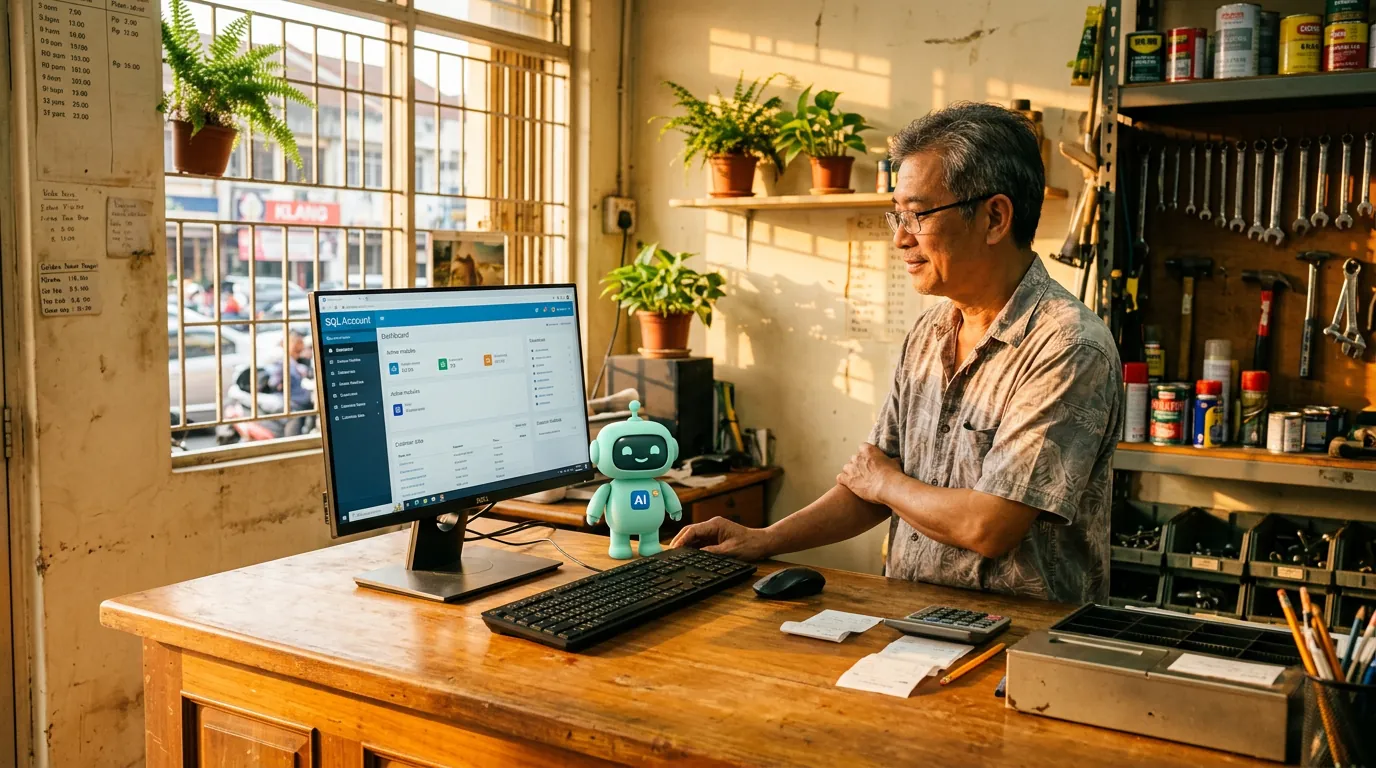
“We were going to migrate to a cloud ERP. The migration was going to take 6 months, the training was going to take 3 more, and the staff were going to hate the new system for a year. The AI on top of the SQL Account we already run shipped in 20 minutes. The cloud ERP is parked.”
— Encik Tan, who runs a 22-person wholesale business in Klang
How to AI-ize what you have (the minidesk overlay)
The AI-ize path is the same shape for every local vendor. Five steps, end to end in twenty minutes for the cloud connectors and a little longer for the desktop connectors (the translator pattern).
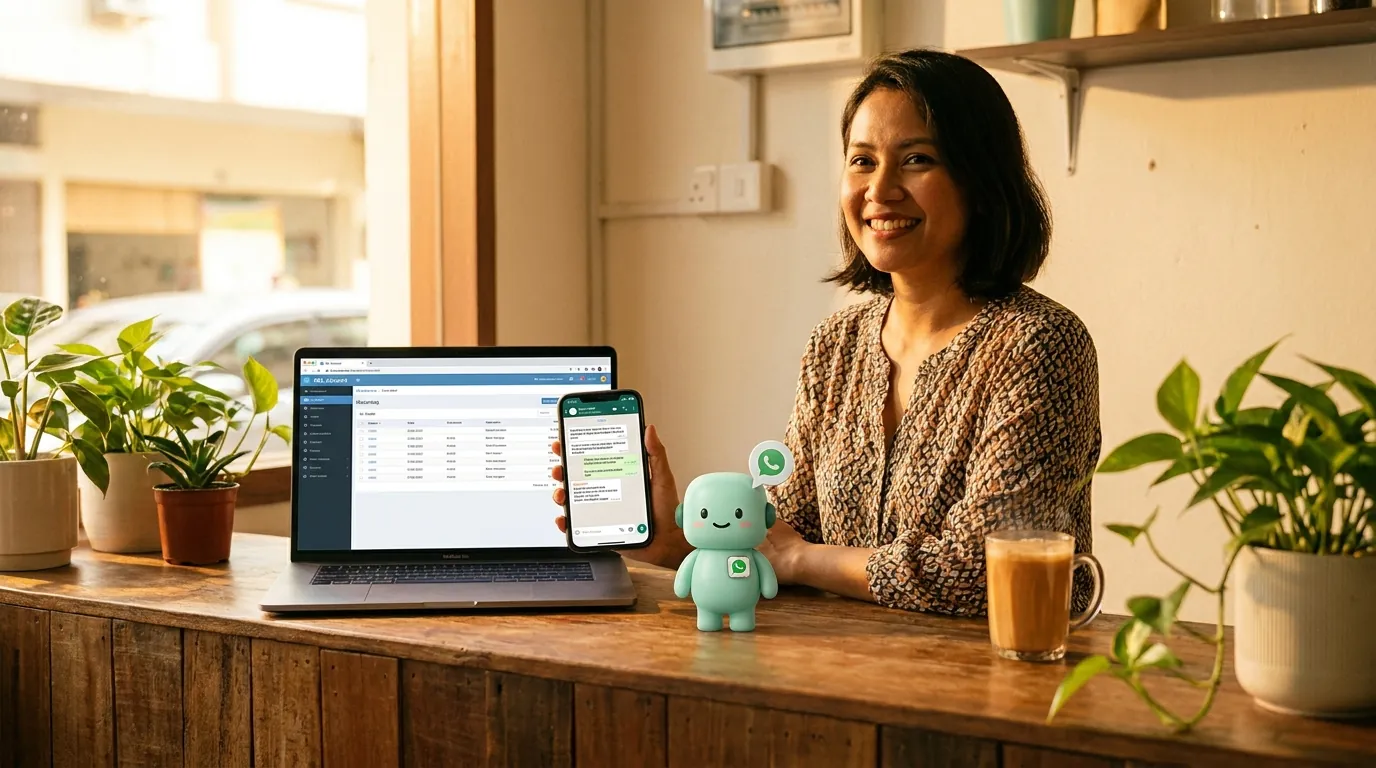
(1) Sign up at minidesk.co and pick your accounting or POS software as the connector. minidesk ships 15 connectors out of the box — the 6 local accounting vendors above, the 4 local POS vendors above, plus the 5 global vendors (Xero, QuickBooks, Sage, MYOB, Loyverse) for the SMEs that already run those. (2) Authorise the OAuth (cloud) or install the translator (desktop). minidesk requests only the scopes the AI needs, and never writes back to the software — every change stays in the software, exactly where the cashier or bookkeeper made it. (3) Connect your business WhatsApp number through Meta Embedded Signup. minidesk holds the Meta Business verification, so the typical 2–4 week wait is gone. (4) Hand the AI its first workflow — the install wizard suggests the first three based on the connector you picked. (5) Run the AI for 30 days, then turn on the next three workflows based on what the staff and the customers have asked for.
The result, at the 30-day mark, is the same shape every connector produces. The AI is reading the software the staff already read, in the language the staff already speak, on the channel the customers already use. The staff are not copying numbers into WhatsApp anymore. The customers are getting the answer in the language they wrote in, in the currency the invoice was raised in, on the WhatsApp they already have open. The MyInvois batch posts to LHDN. The BAS summary posts to the LHDN portal. The overdue reminders go out in Bahasa or English. The staff are back to doing the actual work of the business, not the data-entry of the business.
FAQ
Do I need a bigger ERP, or just the AI layer?
If your business is 1–50 people in services, retail, F&B, or light wholesale, and your bottleneck is the staff copying numbers into WhatsApp, the answer is the AI layer. If your business has multiple legal entities, a multi-country consolidation, or a manufacturing process the local software cannot model, the answer is the bigger system — QNE Acuratica, Sage Intacct, Oracle NetSuite, Microsoft Dynamics 365 Business Central. The honest answer depends on the three signals above (size, multi-entity, channel), not on the vendor brochure.
What is the cheapest way to AI-ize what I already run?
The cheapest path is the minidesk overlay on the software you already pay for. The monthly fee is a flat rate that includes the AI, the channels, the connector, and the WhatsApp API. No migration cost, no training cost, no data-conversion cost. The staff keep using the software they already know. The AI is the new layer between the system and the customer.
Does the AI work with every local accounting vendor?
Yes — the 6 local accounting vendors (SQL Account, AutoCount, Bukku, Access UBS, Million, QNE) plus the 5 global vendors (Xero, QuickBooks, Sage, MYOB, Loyverse-as-accounting) all ship as minidesk connectors. The 4 local POS vendors (StoreHub, Loyverse, FeedMe, Slurp) ship as minidesk connectors. The full list of 15 is on the /integrations page.
Does the AI work with my MyInvois / SST / GST compliance workflow?
Yes. The AI reads the daily sales, drafts the MyInvois e-invoice batch in the UBL 2.1 format LHDN expects, and posts the consolidated batch to LHDN on a schedule you set. The validation response is captured for audit. The same applies to the SST submission and the BAS summary — the AI drafts the submission, the bookkeeper reviews, the AI posts.
How to get started
Three steps, end to end in twenty minutes. (1) Sign up at minidesk.co, pick your accounting or POS software as the connector, and authorise the OAuth (cloud) or install the translator (desktop). (2) Connect your business WhatsApp number through Meta Embedded Signup. (3) Hand the AI its first workflow. The first message lands within the hour. The first invoice posts the next morning. The first WhatsApp reply lands within 20 minutes of the customer's question.
If you are weighing the upgrade-vs-AI-ize decision and you want a second opinion, the install wizard walks you through a 5-minute assessment that maps your three signals (size, multi-entity, channel) to the recommended path. The wizard's read is the honest read, not the read that gets the most licence revenue.
→ See the 15 minidesk integrations: /integrations
→ Read about the local-software-AI wedge: /blog/local-software-ai-wedge