Loyverse + AI: what it actually looks like in 2026
Loyverse is the smartphone-first POS thousands of cafes, salons, retail shops and service businesses in 80+ countries already run. Here is what an AI layer on top of it looks like — and what it does for a 6-outlet bubble tea chain in Klang that wants the per-outlet sales view without the morning spreadsheet.
minidesk · Editorial team, minidesk
You have heard the pitch. \"AI for your POS.\" Every hospitality conference in Petaling Jaya this year has had the same slide. Here is what it means in your business, on the LoyverseLoyverse smartphone POS you already pay for, in the Bahasa Malaysia and English your customers actually write in.
What "AI" means here — the short version
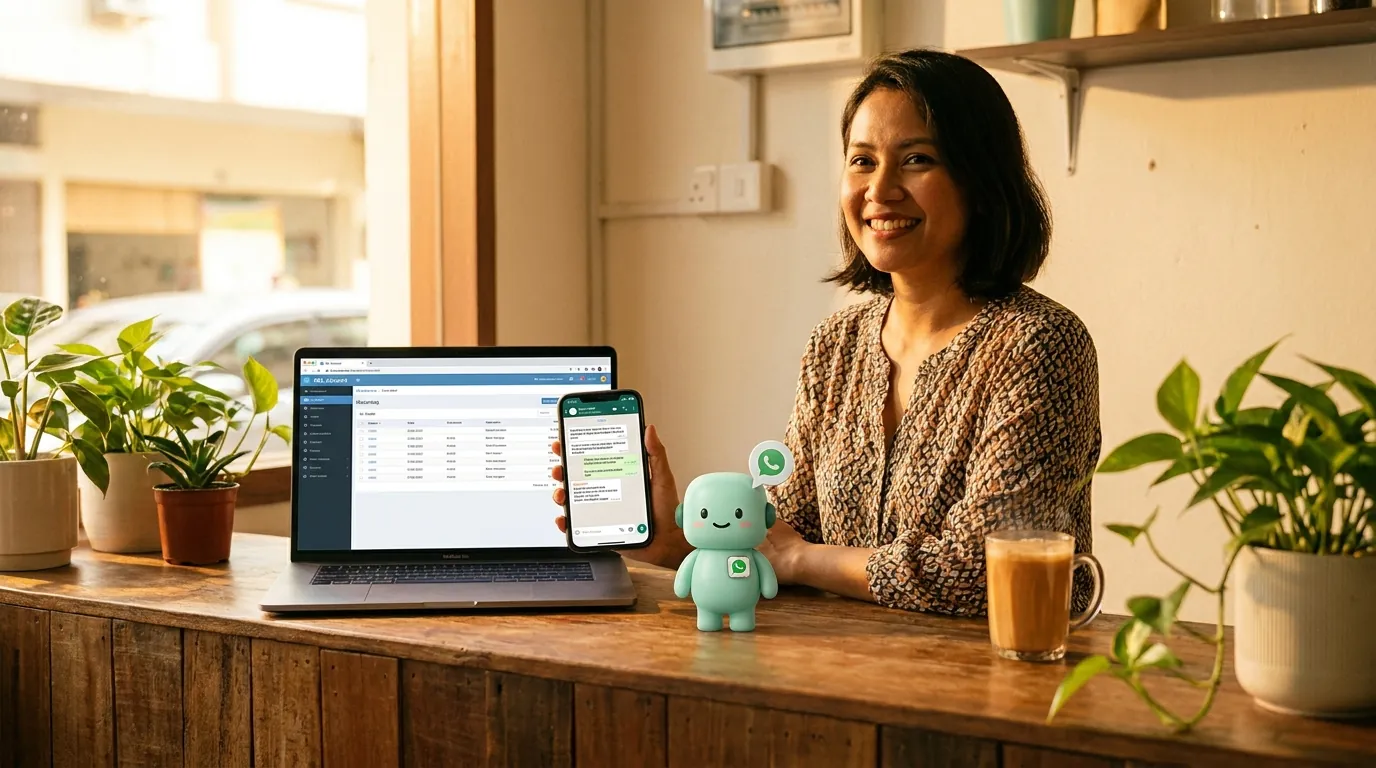
When we say AI on top of Loyverse, we do not mean a chatbot that lives in a tab next to your POS. We mean an assistant that reads the same Loyverse sales database the smartphone app reads — items, modifiers, inventory, customers, receipts, the lot — answers your questions in plain language, and writes back the answers into the same WhatsApp your customers already use. The AI is not a new system. It is a new way to talk to the POS you have been running for two years — the one you chose because it was the smartphone POS that did not need a counter PC and worked the first day your cashier opened it.
What it actually does for a 6-outlet bubble tea chain
Imagine a bubble tea chain Mr Lim runs, six outlets across the Klang Valley, the kind of business where the morning operations meeting starts with someone copying yesterday's sales out of the Loyverse Back Office into a spreadsheet, then into the WhatsApp group, then into the day's prep plan. Loyverse holds every transaction, every modifier (less sugar, more ice, no pearls), every inventory level, every customer order, every outlet's till count. The operations manager lives in the Loyverse dashboard. The customers live in WhatsApp. The morning meeting is the bottleneck.
The minidesk AI reads the same Loyverse data and does four things Mr Lim used to do himself. (1) At 7:30am, the AI sends a WhatsApp to the operations group with yesterday's sales, broken down by outlet, in Bahasa Malaysia. (2) When a customer in Puchong sends a WhatsApp asking for the menu, the AI reads the Loyverse item list, finds the live availability, and replies in Bahasa with the menu, the live prep queue, and the delivery ETA. (3) At 9am every day, the AI drafts the MyInvois e-invoice batch from yesterday's sales and posts it to LHDN. (4) When the AI notices a low-water mark on the brown sugar inventory at the Shah Alam outlet, it sends a WhatsApp to the purchasing manager with the reorder list, in Bahasa, with the supplier contacts attached.
None of that is a different product. It is the same Loyverse Mr Lim has been paying for. The AI is the new interface — the layer that lets the business ask the POS a question in Bahasa and get the real answer back, in the channel the customers already use, in the language the staff already speak.
The bolt-on e-invoicing story — the part Loyverse will not ship
Loyverse is a till. Loyverse is a great till — the smartphone app is the easiest POS to deploy in a pop-up, a market stall, a food truck, a salon chair. But Loyverse is not a tax filing product, and the Loyverse roadmap is not a tax filing roadmap. In every country Loyverse serves, the tax authority wants something Loyverse does not natively produce: Malaysia wants MyInvois e-invoices, Singapore wants GST submissions, the UK wants Making Tax Digital VAT returns, the Philippines wants BIR receipts, South Africa wants SARS VAT201 filings. The list is long; the shape is identical — a regulator wants a structured invoice the till does not produce.
minidesk reads the Loyverse sales feed and produces the structured invoice the tax authority wants, in the format the authority accepts, in the currency the Loyverse receipt was raised in, on a schedule you set. The MyInvois batch posts to LHDN with the consolidated invoice, the UBL 2.1 payload, and the validation response captured for audit. The UK MTD return submits to HMRC with the VAT line, the period, and the digital signature. The South Africa VAT201 file exports to SARS eFiling in the shape the auditor expects. The Loyverse sales feed stays clean; the tax authority gets the document; the business owner does not have to do the typing.
Why Loyverse will not ship this themselves
Loyverse is a POS. Their product is the till, the item list, the modifier, the receipt printer, the inventory, the cash drawer. An AI assistant that reads all of those at once and answers the question in WhatsApp is a different product category. An AI assistant that adds MyInvois / GST / VAT / BIR compliance is a third product category. Loyverse's job is to be the easiest smartphone POS in the 80+ countries it serves. The AI's job is to be the layer on top — the channel, the language, the compliance.
What it looks like across 6 outlets, 4 modifiers, and 3 shifts
The honest test of an AI on a multi-outlet smartphone POS is what happens when the same AI meets 6 outlets, 4 modifiers per item (less sugar, more ice, no pearls, oat milk), 14 menu items, and 3 shifts in the same morning. Here is the test. Mr Lim asks at 7:30am, "bagaimana sales semalam?" The AI reads all 6 outlets, ranks them by sales, identifies the top 5 menu items, flags the 2 low-water marks in the inventory, and writes the WhatsApp in Bahasa Malaysia, with the per-outlet breakdown, the top 5 items, and the reorder list — all in one short message the operations manager reads on the way to the first outlet.
“We chose Loyverse because it was the smartphone POS that did not need a counter PC. The AI is the part that makes the multi-outlet view actually usable — it answers the WhatsApp in Bahasa, in the morning, before the operations meeting starts.”
— Mr Lim, who runs a 6-outlet bubble tea chain in the Klang Valley
The honest limits of the AI
Three limits worth naming, because the limits are the part nobody else puts in the brochure. (1) The AI reads the Loyverse data you have connected. If the item list is a mess (the classic "Mango Slush - 1", "Mango Slush-1", "Mango slushie" problem), the answers will be longer than they need to be. (2) The AI does not write back to Loyverse. Every order and every inventory adjustment stays in the POS, exactly where your cashier made it — the AI is a reader and a writer of WhatsApp, not a writer of POS. (3) The AI is not a replacement for a head chef or an operations manager. It is the layer that lets them stop copying numbers into spreadsheets. The head chef still owns the prep list. The operations manager still owns the morning meeting.
How to add the AI to your Loyverse
Three steps, end to end in twenty minutes. (1) Sign up at minidesk.co, pick Loyverse as the connector, and authorise the OAuth — the same flow you use to link Google Calendar to a third-party app. minidesk requests only the scopes the AI needs: read sales, read items, read inventory, read customers, read receipts. (2) Connect your business WhatsApp number through Meta Embedded Signup. minidesk holds the Meta Business verification, so the typical 2-week Meta wait is gone. (3) Hand the AI its first workflow — "every morning at 7:30am, send me yesterday's sales, broken down by outlet, in Bahasa" — and the first message lands the next morning.
If you want the e-invoice workflow enabled, add it as the second workflow in the install wizard: "every morning at 9am, post yesterday's MyInvois e-invoice batch to LHDN." The wizard walks you through the LHDN credentials, the consolidated-vs-per-receipt mode, and the validation response capture. The first batch posts the next morning, and the AI shows you the validation response in the in-app review queue before anything is finalised in the LHDN portal.
The install is the only part that takes 20 minutes. After that, the AI is reading the Loyverse data on every OAuth refresh — the till count, the items, the inventory, the customers, the receipts, the lot — and the only ongoing work is teaching the AI which workflows matter to your business. The first three are the morning sales summary, the menu auto-reply, and the MyInvois batch. The next three are the ones your operations manager and your head chef will ask for once the first three are running.
→ See the Loyverse integration: /integrations/loyverse